
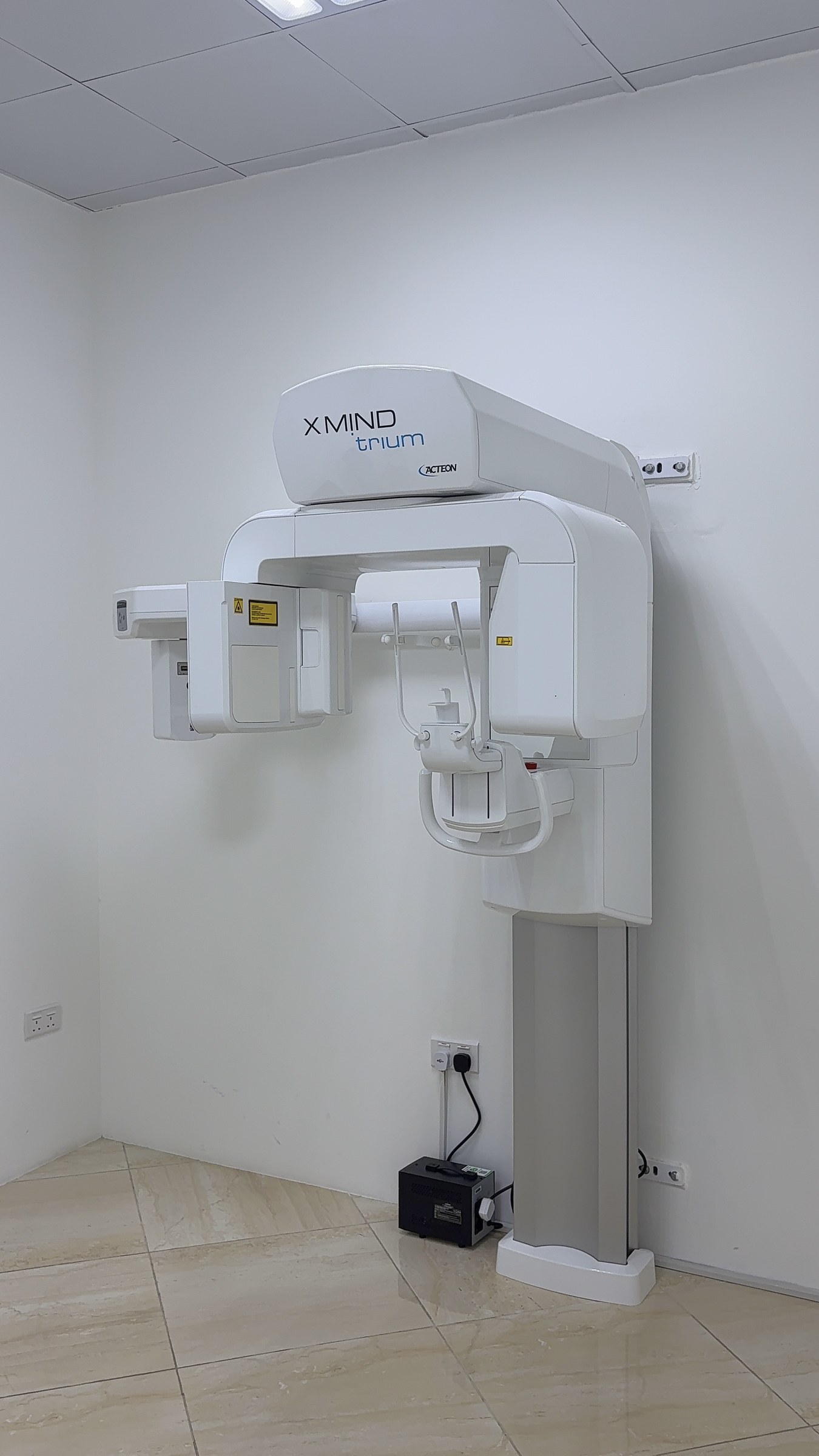
What is a CBCT scan?
CBCT stands for cone beam computed tomography. It's a type of X-ray made for dentistry. While you stand or sit still, the scanner arm turns once around your head and takes a series of images from every angle. Software then builds those images into a 3D model of your teeth, jaws, nerves, sinuses and airway.
That model can be turned, sliced and measured on screen. We can look at a single tooth from the side, check the bone under a missing tooth, or follow the path of a nerve through your jaw. It's the closest thing to seeing inside your mouth without opening anything up.
You might hear it called a "3D dental scan" or "cone beam CT". They all mean the same thing.
What we use it for
A CBCT scan isn't part of every check-up. We use it when a 2D X-ray can't give us enough information to treat you safely. The most common reasons are:
- Dental implants: measuring the height and width of your bone, and finding the nerve and sinus, so each implant goes in the right spot at the right angle.
- Orthodontics: seeing where adult teeth are developing, finding impacted teeth, and checking the roots before and during treatment.
- Wisdom teeth: showing how close a lower wisdom tooth sits to the nerve, which helps plan a safer removal.
- Root canal treatment: finding extra or curved canals and spotting infection or cracks that don't show on a flat X-ray.
- Jaw and joint problems: looking at the jaw joints, bone changes and asymmetry.
- Sinus and airway: checking the sinuses before upper implants and seeing the airway when it's relevant to treatment.
If a regular X-ray is enough, we'll use that instead.
How it compares to a regular dental X-ray
A standard dental X-ray is a flat picture. Everything gets squashed into two dimensions, so structures overlap and it's hard to judge depth. That's fine for spotting decay between teeth or checking a filling, and it's why we still use it every day.
A CBCT scan adds the third dimension. Instead of guessing how thick the bone is or which side of a root the nerve runs, we can measure it. For planning surgery, implants or complex orthodontics, that difference is huge: less guesswork, a more accurate plan, and fewer surprises once treatment starts.
Compared to a medical CT scan at a hospital, a dental CBCT focuses only on your mouth and jaws, so it uses a much lower dose of radiation.
What to expect during your scan
The whole visit takes a few minutes, and the scan itself is over in under a minute.
- Before the scan: we'll ask you to remove earrings, necklaces, glasses, hair clips, removable dentures and anything else metal around your head and neck.
- Positioning: you stand or sit in the scanner. We'll gently guide your head into place and you may bite on a small rest to keep still.
- The scan: the arm rotates around your head once. You'll hear a soft whirring sound. All you need to do is stay still and breathe normally.
- Afterwards: that's it. You can go straight back to your day. There's no recovery time and nothing to wear off.
Your dentist reviews the 3D images and walks you through what they show, usually on screen so you can see it too.
Is a CBCT scan safe?
Yes. A dental CBCT scan uses a low dose of radiation, much lower than a hospital CT scan. Like any X-ray, though, we only take one when the information will change your treatment.
We also keep the dose as low as possible by scanning only the area we need. A scan for a single implant covers a much smaller area than a full jaw assessment.
If you're pregnant or think you might be, tell us before your scan. In most cases we'll postpone it or find another way to get the information we need.
Why it matters for your treatment
Good treatment starts with seeing clearly. With a 3D scan we can plan an implant down to the millimetre, check that a wisdom tooth can come out without touching the nerve, or see exactly where an impacted tooth is before we move it with braces.
It also helps you. We can show you your own scan, explain what's going on and why we're recommending a certain approach. Most patients find it much easier to make a decision once they've seen it for themselves.
If your treatment needs a CBCT scan, we'll do it here in the clinic, so there's no need to book a separate appointment somewhere else.